What's Inside?
- The Foundation: It All Starts with the ʻāina
- The Heavy Hitters: Deconstructing the Iconic Dishes
- Beyond the Big Three: The Supporting Cast
- The Hard Truths: Interruption, Loss, and the Plate Lunch
- The Beautiful Comeback: The Hawaiian Food Renaissance
- Your Guide to Experiencing It Authentically
- Let's Answer Some Real Questions You Might Have
- A Final Thought from the Heart
Let's be honest for a second. When most people think of "Hawaiian food," a very specific image pops up: a plastic lei, a flower print shirt, and a buffet line featuring a roasted pig with an apple in its mouth, next to a bowl of that weird purple paste. I get it. I've been to those hotel luaus. The fire dancing is incredible, but the food often feels like a side note, a checked box on the tourist itinerary.
But here's the thing. That version is a performance, a commercial shell of something profoundly deep and sacred. Real Hawaiian cultural foods are something else entirely. They're not just about taste; they're about story, spirituality, family, and a direct connection to the land and sea, or what Hawaiians call ʻāina. The food is the culture, baked (or, more accurately, steamed in an imu) into every bite.
I remember the first time I tasted poi made by an auntie in a backyard in Hilo, not scooped from a stainless-steel hotel pan. The difference wasn't just in texture or temperature. It was in the care, the conversation around it, the way it was shared. That experience flipped a switch for me. This article is my attempt to pass on that understanding, to look past the pineapple garnish and dive into the heart of what makes these foods so special and enduring.
Before we start, a quick note on respect: Hawaiian culture is living and deeply cherished. When we talk about these foods, we're talking about the heritage of the Kānaka Maoli (Native Hawaiian) people. It's a history marked by both incredible resilience and profound loss. Approaching this topic means doing so with respect for its origins and the people who keep it alive today.
The Foundation: It All Starts with the ʻāina
You can't talk about the food without understanding the land. Traditional Hawaiian society was organized around the ʻahupuaʻa, a land division system that ran from the mountains (mauka) to the sea (makai). This wasn't just real estate; it was a blueprint for sustainable living. Villages within an ʻahupuaʻa had access to everything they needed: forest resources, fertile land for farming, and ocean fisheries.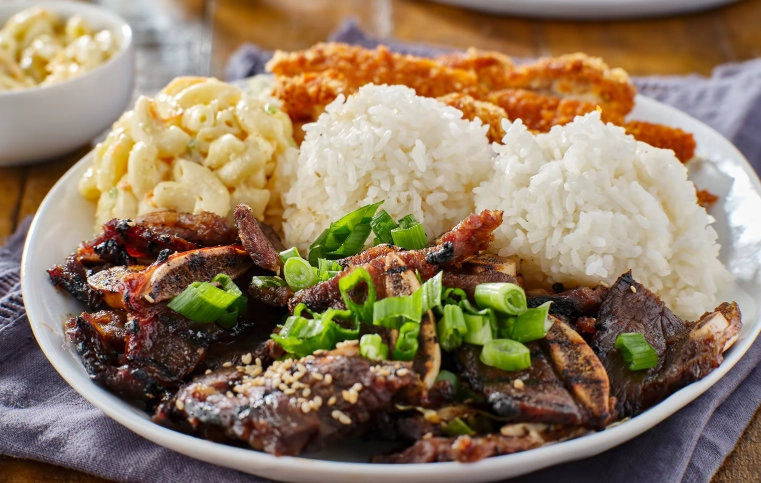
The food system was built on this genius model. It meant that the diet was inherently local, seasonal, and incredibly diverse. The concept of ʻāina goes beyond dirt and trees; it means "that which feeds." The land is a relative, a provider. This relationship of respect and reciprocity is the bedrock of all Hawaiian cultural foods. You take care of the land, and it takes care of you. Period.
This connection explains why certain ingredients are non-negotiable pillars. They weren't just crops; they were life.
The Canoe Plants: The Original Immigrants
When the first Polynesian voyagers navigated thousands of miles to reach the Hawaiian Islands, they didn't come empty-handed. Their double-hulled canoes were floating arks, carrying the plants essential for survival. These are the "canoe plants," and they form the absolute core of the cuisine.
- Kalo (Taro): This is the big one. More than just a root vegetable, kalo is considered the elder brother of the Hawaiian people in the creation chant, the Kumulipo. From a cosmic perspective, that's a pretty important resume. Every part of the plant is used, but the corm (the bulb-like root) is mashed into poi.
- ʻUala (Sweet Potato): A hardy and nutritious staple that could grow in less water-rich areas than kalo. It was baked, steamed, or dried for preservation.
- Ulu (Breadfruit): A prolific tree that produces starchy, versatile fruits. When cooked, it has a potato-like or bread-like texture (hence the name). It can be roasted, fried, or pounded into a paste.
- Maiʻa (Banana): Dozens of varieties were brought, not just the sweet Cavendish we eat today. Some were specifically for cooking.
- Niu (Coconut): The ultimate utility plant. Water, milk, cream, meat, and even the husks and shells had uses.
These plants didn't just feed the body; they shaped the society. The cultivation of kalo in intricate loʻi (irrigated pondfield systems) required and fostered community cooperation. The food source directly influenced the social structure.
The Heavy Hitters: Deconstructing the Iconic Dishes
Okay, so let's get into the dishes you've heard of. But instead of just listing them, let's look at why they are the way they are. The preparation methods were brilliant solutions to the challenges of time, tools, and feeding large communities.
Poi: The Sacred Staple
Let's address the purple elephant in the room. Poi is steamed or baked kalo corm, pounded on a wooden board (papa kuʻi ʻai) with a stone pounder (pōhaku kuʻi ʻai) until smooth, then mixed with water to the desired consistency.
Honestly, the first time I tried it, I didn't get it. It's slightly sour, earthy, and the texture can be... challenging for the uninitiated. Calling it "Hawaiian mashed potatoes" does it a massive disservice. It's an acquired taste, for sure. But understanding its context changes everything.
It was the primary carbohydrate, eaten with almost every meal. Its consistency is described by "fingers":
- One-finger poi is so thick you eat it with one finger (you scoop it and it sticks).
- Two-finger poi is the most common, medium thickness.
- Three-finger poi is thin, almost drinkable, often fed to babies or the elderly.
Its mild, slightly fermented flavor makes it the perfect counterbalance to the rich, salty flavors of other Hawaiian cultural foods like kalua pig or lomi salmon. It's not meant to be the star of the show; it's the foundational canvas. It's also incredibly digestible and hypoallergenic, which is why it's often a baby's first food. To dismiss poi is to miss the point entirely. It's humility. It's sustenance. It's family.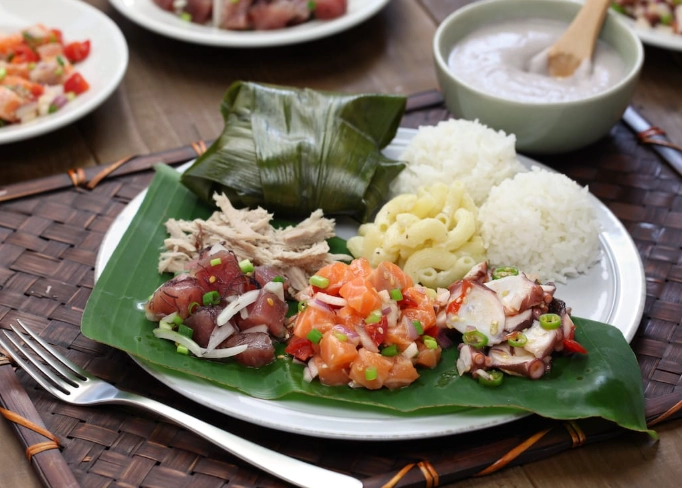
Kalua Pig: The Earth Oven Masterpiece
This is the one everyone knows. But the real deal is a far cry from the "kalua pork" you might get in a fast-casual bowl place on the mainland. Authentic kalua pig is cooked in an imu, an underground oven. Here's the process, which is a community event in itself:
- A pit is dug in the ground.
- A fire is built inside using specific woods like kiawe (mesquite) to heat volcanic rocks until they're white-hot.
- The rocks are spread out, and layers of banana stumps, ti leaves, and sometimes burlap sacks are placed over them to create steam.
- The whole pig (seasoned traditionally with just Hawaiian sea salt) is lowered in.
- More layers of vegetation (banana leaves, ti leaves) cover the pig.
- A canvas tarp is laid over everything, and the whole thing is buried with dirt to trap the heat and steam for 6-8 hours.
The result? Meat so tender it falls apart, infused with a smoky, earthy flavor that no commercial oven or liquid smoke can ever replicate. The word "kalua" literally means "to cook in an underground oven." So if it's not from an imu, it's just roasted pork. The imu isn't just a cooking method; it's a ceremony that connects the food to the earth literally and spiritually.
Laulau: The Perfect Package
Laulau is the ultimate example of ingenious, portable cooking. It's a bundle of pork, beef, or chicken, and sometimes a piece of butterfish (black cod), wrapped in layers of luʻau leaves (the young, tender leaves of the kalo plant) and ti leaves. The bundle is then steamed for hours.
The ti leaf wrapping is inedible and just for cooking (it gives a unique floral note), but the luʻau leaves inside become soft, spinach-like, and soak up all the glorious juices from the meat. It's a self-contained, flavor-bomb meal. You untie the bundle, discard the ti leaf, and dig in. The luʻau leaves can be an acquired texture, but when done right, they're silky and rich. A poorly made laulau will have tough, bitter luʻau leaves—a sure sign it wasn't steamed long enough.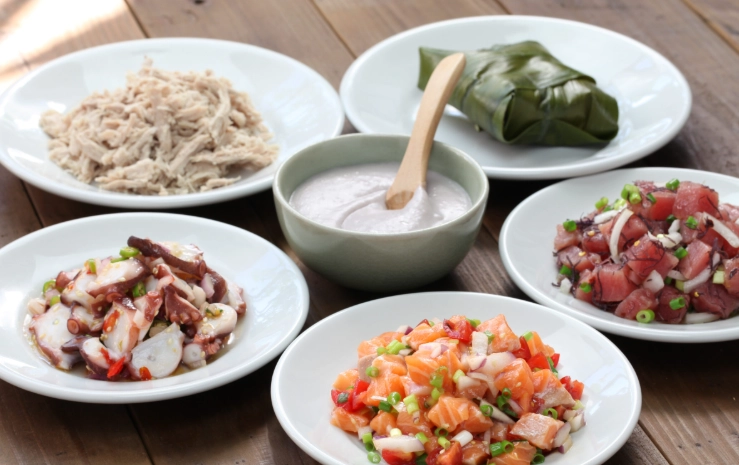
Beyond the Big Three: The Supporting Cast
A plate of Hawaiian cultural foods is a symphony, not a solo act. Here are the essential sides that complete the picture:
- Lomi Lomi Salmon: A refreshing salad of salted salmon, tomatoes, and sweet Maui onions, "lomi-lomi" (massaged) together by hand. The saltiness of the salmon cuts through the richness of the other dishes. It's a post-contact food (salmon was introduced), but it's been wholly adopted and perfected.
- Haupia: A simple, creamy coconut milk-based pudding set with arrowroot or cornstarch. It's subtly sweet, jiggly, and the perfect clean finish to a heavy meal. Don't expect an overly sweet, firm dessert; its elegance is in its simplicity.
- Poke: Yes, the bowl trend that swept the planet. But traditional Hawaiian poke (pronounced poh-keh) is much simpler than the avocado-ed, mango-sauced versions. It's simply fresh, raw fish (typically ʻa hi (yellowfin tuna)) cubed and seasoned with sea salt, inamona (roasted crushed kukui nut), and limu (seaweed). It's about highlighting the quality of the fish. The modern iterations are delicious, but that's a different conversation.
Pro Tip for the Modern Eater: The classic "plate lunch" order is a great way to sample: get a scoop of rice, a scoop of mac salad (a local favorite, though not traditionally Hawaiian), and your choice of kalua pig, laulau, or chicken long rice. It's the working-class, everyday expression of these flavors.
The Hard Truths: Interruption, Loss, and the Plate Lunch
We have to talk about 1778. Captain Cook's arrival didn't just bring new people; it brought new plants, animals, diseases, and a completely foreign economic and land ownership system (the Great Māhele). The impact on Hawaiian cultural foods was catastrophic.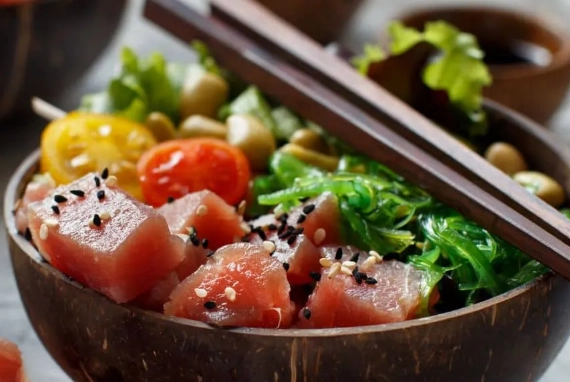
The traditional ʻahupuaʻa system was dismantled. Lands were privatized for sugar and pineapple plantations. These monocrops required massive amounts of water, diverting it from the loʻi kalo, which withered. Native Hawaiians were displaced from their lands and their food sources. The population plummeted due to introduced diseases.
The diet was forced to change. Imported canned meats (like Spam) and white rice became cheap staples. What emerged was a survival cuisine—a fusion born of necessity, not just curiosity. Dishes like loco moco (rice, hamburger patty, fried egg, gravy) or Spam musubi are brilliant, tasty adaptations, but they speak to a period of cultural disruption and economic hardship. They are part of Hawaii's food story, but they are distinct from the pre-contact Hawaiian cultural foods. Confusing the two erases a difficult history.
The Beautiful Comeback: The Hawaiian Food Renaissance
This is the most exciting part of the story. For the last several decades, there has been a powerful movement to revive the language, culture, and yes, the food. It's not about going back in time, but about reconnecting with the wisdom of the past to build a healthier, more sustainable future.
Across the islands, you'll find:
- Loʻi Kalo Restoration: Community groups are clearing ancient irrigation systems and replanting kalo. Places like Kahumana Organic Farm in Waiʻanae are doing incredible work integrating traditional farming with social enterprise.
- Chefs as Advocates: Chefs are moving beyond just using the ingredients as novelty. They are researching traditional preparations, building relationships with farmers, and telling the food's story on the plate. The work of chefs like Mark "Gooch" Noguchi is essential here.
- Education in Schools: ʻAina-based education programs are teaching kids to grow, harvest, and prepare traditional foods, rebuilding that fundamental connection.
- New Traditions: It's not a museum piece. Innovative farmers are growing heirloom canoe plant varieties, and cooks are finding new contexts for them while respecting their essence.
This revival is about sovereignty. It's about health—combating the diabetes and heart disease that came with the Western diet. It's about identity. The food is a powerful pathway back.
Your Guide to Experiencing It Authentically
So, you're going to Hawaii and you want to taste the real deal, not just the tourist version. Where do you go?
For a True Cultural Immersion (Often on Oʻahu):
- Helena's Hawaiian Food (Honolulu): A legendary, no-frills spot that's been serving classics since 1946. Be prepared to wait in line. It's worth it.
- Waiahole Poi Factory (Windward Oʻahu): Not a factory in the industrial sense. They make fresh, hand-pounded poi and serve simple, excellent plates in a historic setting.
- Highway Inn (Honolulu): Another multi-generational favorite that respects the classics while also celebrating the local mixed plate legacy.
Look for Community Events:
Check local event calendars for ʻāina festivals, farmer's markets that feature Hawaiian crop growers, or fundraisers for loʻi restoration. The food at these events often has a level of heart and purpose you won't find elsewhere.
| Aspect | Traditional / Authentic Experience | Commercial / Tourist Experience |
|---|---|---|
| Poi | Hand-pounded, fresh, varying consistencies (1-3 finger), slightly sour. Served as a staple. | Often pre-made, uniform, paste-like. Treated as a curious side dish. |
| Kalua Pig | Cooked in a real imu (earth oven), smoky, earthy flavor, seasoned with just salt. | Often oven-roasted or steamed with liquid smoke flavoring. |
| Setting | Local restaurants, family gatherings, community events. Focus on food and ʻohana (family). | Hotel luau shows. Focus is on the performance; food is mass-catered. |
| Goal | Nourishment, cultural connection, continuity. | Entertainment, photo opportunity. |
Let's Answer Some Real Questions You Might Have
A Final Thought from the Heart
Writing this made me hungry, but also reflective. Exploring Hawaiian cultural foods isn't a culinary scavenger hunt to check off a list. It's an invitation to understand a worldview.
It's about seeing a bowl of poi not as a bland paste, but as the embodiment of a family relationship between people and the land. It's about seeing the imu not as a primitive BBQ, but as a testament to communal effort and harnessing the earth's energy with reverence. The depth is in the context.
The next time you have the chance to taste these foods, I hope you taste a bit of that history too—the resilience, the loss, and the powerful, growing hope of the revival. The story of these foods is still being written, and that might be the most delicious part of all.
Go find a plate. Talk to the people making it. Ask questions. And most importantly, just enjoy it for the incredible, living tradition that it is.
Reader Comments